
What your face and body teach your child about safety

Long before your child can weigh up a situation for themselves, they are reading you.
Not your words. Your face, your shoulders, the speed of your voice. Children work out whether something is safe by checking the nearest trusted adult, and most of the time that adult has no idea they are being consulted.
What affect actually is
Affect is the word for how emotion shows up on the outside. Facial expression, body language, tone of voice. It is how the feelings happening inside us become visible to everyone else.
It matters here because affect is the part of you your child can actually read. They cannot see your reasoning. They can see your jaw.
Social referencing, and why it isn’t clinginess
When a child meets something new or uncertain, one of the first things they do is check in with your affect. They glance at your face, your posture, your tone, before deciding how to feel about what is in front of them.
This is called social referencing, and it is a normal, well-researched part of early development. It is not a sign of anxiety or over-dependence. It is how a child’s nervous system gathers information before they have built up enough experience of their own.
A classic example. A child at the pool watches someone dive off the board for the first time. It could look thrilling or terrifying, and they don’t yet know which. So they look to you. If your affect is relaxed and pleased, that tells their nervous system this is okay. If your affect shifts to tension or alarm, that tells them something here is wrong.
Researchers tested exactly this with babies and a glass floor. In the visual cliff studies run by Sorce, Emde, Campos and Klinnert, a drop-off was set at a height ambiguous enough that babies genuinely didn’t know what to make of it, so they looked to their mothers. When mum posed joy or interest, most of them crossed. When she posed fear, none of them did. Same floor, same baby, different face.
Why this matters over time
Across hundreds of small moments like that, children build a kind of internal map of what is safe and what is worth worrying about, largely from watching the adults around them.
It works in both directions.
- A child who regularly sees a parent worried, tense or bracing for problems in everyday situations can absorb the message that the world is generally something to be wary of.
- A child who sees the same situations met with steadiness gets a different message, one of safety and manageability, even in moments that are genuinely hard.
There is a mechanism underneath this, and it is worth naming. One of the most powerful ways young children learn to regulate their energy and emotions is through co-regulation. Co-regulation is the reciprocal process by which one nervous system’s cues of safety help shift another nervous system’s state.
Which is also why a blank face is not a neutral one. In the still-face studies, first run by Ed Tronick and colleagues, a parent holds eye contact but lets their face go flat and unresponsive. Babies work hard to get them back, and become distressed within a couple of minutes. Children are not just reading your affect. They are relying on it.
This is not about masking how you feel
None of this means parents need to perform, suppress or pretend. It is specifically about body language and tone in the small, everyday moments where a child is looking for a read on the situation.
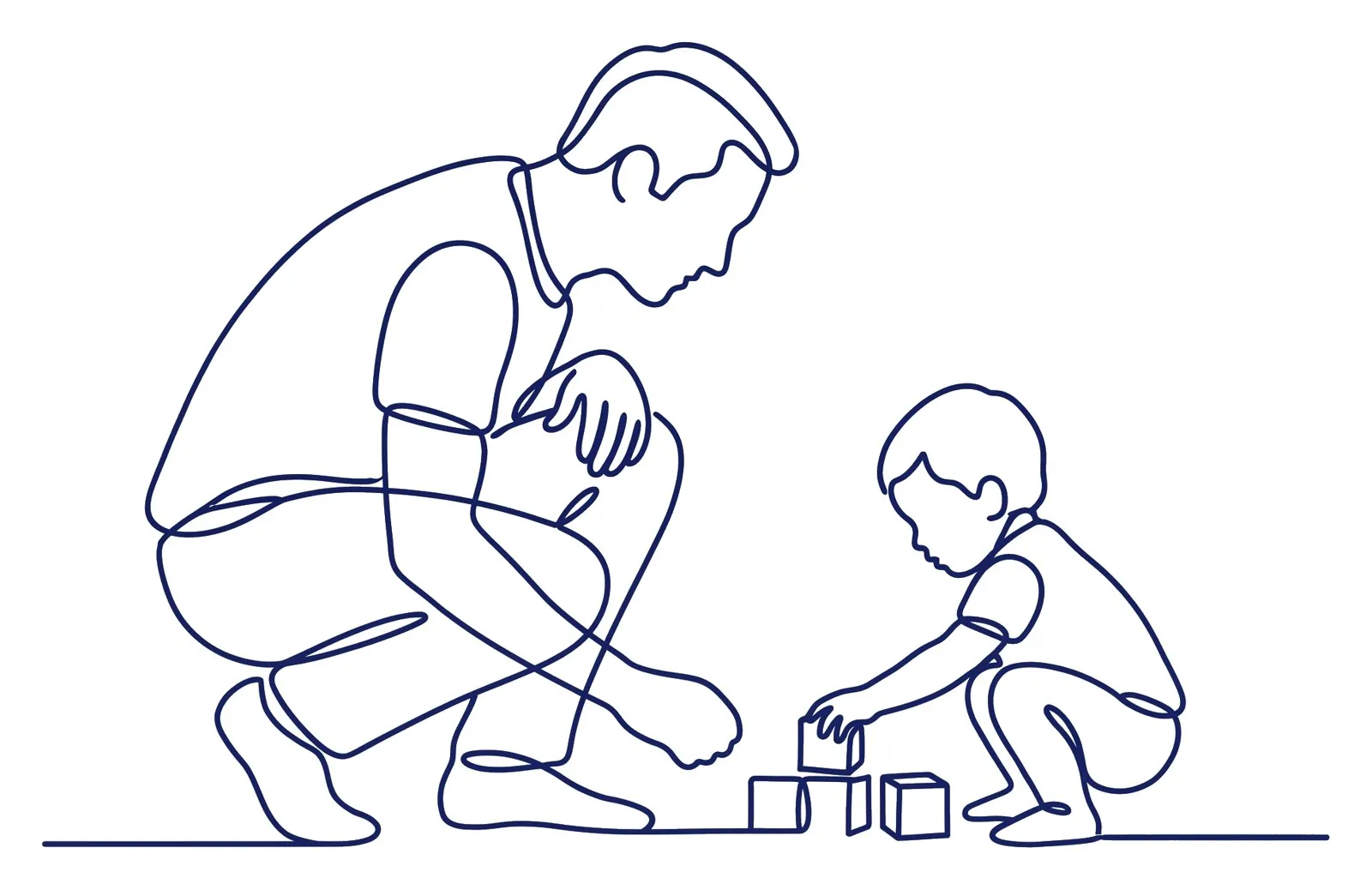 Match first, then lead. Come down to where they are before you bring the energy down.
And steady does not mean flat, or quiet, or endlessly cheerful. In practice it often means turning the volume down rather than switching the feeling off. Affect is the observable part of emotion, so we use intentional, contained enthusiasm. Less words, more body language.
For a child who is already wound up, matching before you lead works better than asking them to come straight to your level. If he’s very energetic, start by joining him in his play at that level, then gradually model calming your pace and voice so he can follow your lead.
Validating and staying steady can both be true at once
This is not about dismissing a child’s fear or pretending everything is fine. A child’s discomfort is real and deserves to be taken seriously.
Take a child who is frightened of haircuts. You can hold both things together:
“I know this is hard. It’s okay to feel scared. We’ll do what we can to make it easier, and I’m right here.”
The feeling gets validated. Your body stays regulated. Both matter, and they are not in competition.
What’s in your control, and what isn’t
You can’t control how your child feels in the moment. Their fear is theirs, and it’s valid.
What you can work on is your own nervous system. Noticing what sets you off, and building your own capacity to stay steady when things feel hard. Not performing calm, genuinely doing the groundwork. Understand your own triggers, model self-compassion, and accept that we’re all on our own journey.
Three things that make that groundwork more realistic:
- Say the quiet part out loud. Children see the moments you lose it and almost none of the moments you held it together, because the holding is invisible. Narrating it puts it back on the record. “I’m feeling frustrated, so I’m going to take a big breath before I answer.” So that she can see all the time you spent regulating, and not just the times you weren’t able to, because it’s not possible to be perfect every time. We’re all human.
- Remember it becomes their inner voice. How we talk to and around our kids becomes their inner voice, so we can model what this looks like and subconsciously feed into that database. That includes how you talk to yourself in front of them.
- Be realistic about what refills you. Traditional self care like taking a nap or taking a break isn’t always an option, and for the parents of neurodivergent kids the fallout of stepping out at the wrong point can derail an entire day. You then spend extra energy trying to reregulate a child who didn’t have your co-regulation when they needed it. Small and well-timed usually beats big and badly timed.
The takeaway
You don’t need to fix how your child feels. You need to keep working on how you respond. That’s the part within your control, and it’s a powerful one.
So the question worth sitting with isn’t “how do I stop them being scared of this?”
It’s: what is my body language telling them about how scary this is?
Where this comes from
- Sorce, J. F., Emde, R. N., Campos, J. J., & Klinnert, M. D. (1985). Maternal emotional signaling: Its effect on the visual cliff behavior of 1-year-olds. Developmental Psychology, 21(1), 195–200.
- Tronick, E., Als, H., Adamson, L., Wise, S., & Brazelton, T. B. (1978). The infant’s response to entrapment between contradictory messages in face-to-face interaction. Journal of the American Academy of Child Psychiatry, 17(1), 1–13.
This is general information, not individual advice. If you’d like support working out what helps your child feel safe, and what helps you stay steady alongside them, an occupational therapist can work through it with you.